“stream” search results (955)

Galapagos coffee producing area Galapagos coffee flavor
Coffee production in the Galapagos Islands: coffee is grown in San Cristobal (SaintCristobal). Arab bourbon coffee trees are planted in the Hasunda Coffee Garden (HaciendaElCafetal) in San Cristobal. The elevation of the plantation is between 140 and 275 meters above sea level, and the climate in this area is equivalent to that between 915 and 1830 meters inland, so the gradient is suitable for high acidity.
2016-08-29 Lapa Goss Coffee producing area Flavor Islands Origin
Ethiopian Coffee Variety Yega Xuefei
These mountain villages are foggy, like spring all year round, with a gentle breeze in summer, cool but not hot, rain but not damp, and no cold damage in winter, giving birth to a unique regional flavor of citrus and flowers. Coffee trees are mostly planted in farmers' backyards or mixed with other crops in the fields. Ethiopia's Yirgacheffe coffee, though petite, is gentle and sweet.
2016-06-01 Ethiopia coffee varieties Yega Sheffield these mountain streams small villages fog
Varieties of coffee trees
1.5 Arabica coffee varieties improved Arabica coffee beans include traditional varieties that are very close to the original, as well as mutants or hybrids mated with Robusta. Coffee variety improvement is not only limited to the fight against diseases and insect pests, but also the pursuit of a steady stream of harvests. 1. The variety of Arabica coffee belongs to the evergreen shrub Ara of the genus Rubiaceae.
2014-07-04 Coffee knowledge coffee trees varieties coffee encyclopedia
Galapagos coffee with rich sour and sweet taste
Galapagos Islands Coffee Market: due to the unique role of the Galapagos Islands in the course of history, the Ecuadorian government has designated the Galapagos Islands as a national park and no longer allows the land to be reclaimed as new agricultural land. and the introduction and use of chemical fertilizers, pesticides, herbicides and other chemicals are strictly prohibited, so Galapagos coffee is recognized as a natural product.
2016-06-17 Taste rich sour sweet Lapa Goss coffee archipelago
How to make a good siphon coffee
1. Siphon coffee is best made without hot water or boiled water, because the more dissolved oxygen in the water (there is almost no dissolved oxygen in hot and boiled water) and the higher the hardness of calcium and magnesium ions in the water (calcium and magnesium ions, not copper, iron, lead and mercury ions), the deeper the metasomatism replacement reaction between water and the good substances in coffee powder, the easier it is to replace the good taste. I added a high calcium and magnesium ion here.
2014-08-05 Coffee knowledge siphon pot coffee encyclopedia
How to make a good siphon coffee
1. Siphon coffee is best made without hot water or boiled water, because the more dissolved oxygen in the water (there is almost no dissolved oxygen in hot and boiled water) and the higher the hardness of calcium and magnesium ions in the water (calcium and magnesium ions, not copper, iron, lead and mercury ions), the deeper the metasomatism replacement reaction between water and the good substances in coffee powder, the easier it is to replace the good taste. I added a high calcium and magnesium ion here.
2015-07-29 How a cup delicious siphon coffee
Basic exercise of Coffee drawing-drawing Water
The purpose of basic practice of drawing flowers is to draw water. Practice stability 2. To master the sloshing skill exercise 1, pour the water into the cup with a milk kettle, starting from the mouth of the cup, then raise the milk kettle until the spout is about three to five inches high from the mouth of the cup, and pour into the cup with a column of water of the same thickness, but the water column should be thick enough. put the milk kettle close to the edge of the cup when it is seven minutes full until it is full.
2014-09-05 Coffee flower drawing basic exercise
Galapagos Coffee introduction
In 1875, ManuelJ.Cobos, an indigenous Ecuadorian, began to grow Arabic bourbon coffee trees in the Hasunda Coffee Garden (HaciendaElCafetal) in San Cristobal. Coffee production in the Galapagos Islands: coffee is grown in San Cristobal (SaintCristobal). Inner species of Hasunda Coffee Garden (HaciendaElCafetal) in San Cristobal
2016-08-30 Lapa Goss Coffee introduction 1875 Ecuador Aboriginal worth M.
Galapagos coffee producing area Galapagos coffee flavor Galapagos coffee characteristics
In 1875, ManuelJ.Cobos, an indigenous Ecuadorian, began to grow Arabic bourbon coffee trees in the Hasunda Coffee Garden (HaciendaElCafetal) in San Cristobal. Coffee production in the Galapagos Islands: coffee is grown in San Cristobal (SaintCristobal). Inner species of Hasunda Coffee Garden (HaciendaElCafetal) in San Cristobal
2016-09-01 Lapa Goss coffee producing areas flavors characteristics 1875 Ecuador soil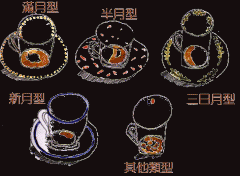
General knowledge of boutique coffee culture Greek coffee fortune telling
Coffee divination, also known as "Greek coffee divination" or "Turkish coffee divination", is also popular in countries once ruled by the Ottoman Turkish empire. The origin of coffee divination due to the continuous disputes between Turkey and Greece before, so if you come to Greece, don't say you want a cup of Turkish coffee, otherwise you will get two.
2014-12-24 Boutique coffee culture common sense Greece coffee fortune telling divination Quan
Introduction to the characteristics of Ugandan coffee bean flavor and taste manor with unique flavor
Uganda is a landlocked country in eastern Africa, straddling the equator, bordering Kenya to the east, Tanzania and Rwanda to the south, the Democratic Republic of the Congo to the west and Sudan to the north. Most of the territory is located in the Central African Plateau, with lakes, with an average elevation of 1000,000,000 meters above sea level. There are many lakes and plateaus in the mountains, which are known as the water villages of the plateau. The western branch of the East African Rift Valley runs through the western border, with many rivers and lakes at the bottom of the valley. There is a Victor in Uganda.
2016-08-03 With unique flavor Uganda coffee beans taste manor producing area characteristics introduction
Coffee in the Galapagos Islands
In 1875, Manuel J. Cobos, an indigenous Ecuadorian, began growing arabic bourbon coffee trees on Hacienda El Cafetal in San Cristobal. Coffee growing in the Galapagos Islands: Coffee is grown in Saint Cristobal. Hacienda El Cafetal in San Cristobal
2014-12-18 Boutique Coffee Recommended Lapa Goss Archipelago 1875 Ecuador Earth
Coffee producing area-Galapagos Islands
Coffee is grown in Saint Crst ó bal. St. Cristobal is a larger island in the Galapagos Islands (Galapagos Islands) and the only one in the archipelago with plenty of fresh water.
2014-08-21 Coffee knowledge coffee producing area Galapagos Islands
Coffee from the Galapagos Islands
In 1875, Manuel J. Cobos, an indigenous Ecuadorian, began growing arabic bourbon coffee trees on Hacienda El Cafetal in San Cristobal. Coffee growing in the Galapagos Islands: Coffee is grown in Saint Cristobal. Hacienda El Cafetal in San Cristobal
2015-05-14 Coffee Country of Origin Introduction Lapa Goss Archipelago 1875 Ecuador Turkey
Basic exercise of espresso flower drawing-drawing water
Objective 1. Practice stability 2. Preliminary grasp of shaking skills exercise 1: pour the water into the cup with a milk kettle, starting from the mouth of the cup, then pull the kettle up to the spout about three to five inches high from the mouth of the cup, and pour into the cup with a column of water of the same thickness, but the water column should be thick enough. put the milk kettle close to the edge of the cup when it is seven minutes full until it is full. OK, after practice, do you see any bubbles when you pour in?
2014-10-22 Coffee knowledge coffee pull Italian coffee pull flower drawing practice
How to make a good siphon coffee by brewing coffee
1. Siphon coffee is best made without hot water or boiled water, because the more dissolved oxygen in the water (there is almost no dissolved oxygen in hot and boiled water), the higher the hardness of calcium and magnesium ions in the water (calcium and magnesium ions, not copper, iron, lead and mercury ions). The deeper the metasomatic replacement reaction between water and the good substances in coffee powder, the easier it is to replace the good taste. I added a high calcium and magnesium ion here.
2015-01-17 Brewing coffee technology how a cup delicious siphon the best
Among the three major non-volcanic coffee producing areas in Guatemala, the tiny Tenango Highland has the driest climate and the sea.
Highland Huehue: of the three major non-volcanic coffee producing areas in Guatemala, the Ginango Heights has the driest climate and the highest elevation. The dry and hot wind from Mexico's Tehuantepec plateau protects the area's coffee from frost, and coffee can be grown to 2000 meters (6500 feet). Because of its remote location, all coffee
2016-05-09 Guatemala Big three Volcanoes Coffee producing areas Micro Tenan Highlands Climate dry
Among the three major non-volcanic coffee producing areas in Guatemala, the tiny Tenango Highland has the driest climate and the sea.
Highland Huehue: of the three major non-volcanic coffee producing areas in Guatemala, the Ginango Heights has the driest climate and the highest elevation. The dry and hot wind from Mexico's Tehuantepec plateau protects the area's coffee from frost, and coffee can be grown to 2000 meters (6500 feet). Because of its remote location, all coffee
2016-05-09 Guatemala Big three Volcanoes Coffee producing areas Micro Tenan Highlands Climate dry
Global Coffee producer-Galapagos
In 1875, ManuelJ.Cobos, an indigenous Ecuadorian, began to grow Arabic bourbon coffee trees in the Hasunda Coffee Garden (HaciendaElCafetal) in San Cristobal. Coffee production in the Galapagos Islands: coffee is grown in San Cristobal (SaintCristobal). Inner species of Hasunda Coffee Garden (HaciendaElCafetal) in San Cristobal
2014-07-09 Coffee origin coffee production global coffee producing area
Introduction to the rising Silence Cafe in Silent cafes attract Japanese Japan
A young woman sits alone in a caf sipping tea and reading a book. A young lady sat alone in a cafe, sipping tea while reading. She pauses briefly to scribble in a nearby notepad before showing her words to a passing caf worker: Where are the toilets ple
2015-12-15 Silent cafes attract Japanese