“Lujiang” search results (123)

Introduction to the characteristics of Katim Coffee varieties treated by Flavor and Taste Grinding degree in Yunnan Province, China
Katim coffee bean is a variety with high and stable yield. The results of trial planting in different ecological areas show that as long as it is planted in accordance with high-yield cultivation techniques, a higher yield will be obtained, with an average yield of more than 150 kg per mu and a small area of more than 400 kg. 1. The state-run Lujiang Farm in Baoshan City planted 12.6 mu in March 1991. The land has no shade and is irrigated once in the dry season.
2016-10-20 China South Carolina Tim Coffee Flavor Taste Grinding processing varieties characteristics
Introduction to the flavor description and treatment of Yunnan small-grain coffee Huaguoshan coffee
Although the environmental problems of coffee cultivation can reach the standard of hot areas, they are far away from the equator, evaporation, large-scale coffee cultivation in Yunnan is less than 1100m above sea level, the severe drought in Yunnan in recent years, and the frost period in the producing areas, and so on, all make coffee planting can not be guaranteed normally, which directly affects the quality of coffee production. As for other processing problems, not to mention the quality of farmers, tea
2016-10-17 Yunnan small grains Coffee Huaguoshan Flavor description treatment characteristics Variety taste
Tippi Katim Coffee Flavor description characteristics of Grinding degree introduction of high-quality coffee beans in producing areas
Baoshan Lujiangba belongs to the south subtropical, northern tropical and semi-dry tropical climate, which is very suitable for the growth of small-grain coffee. The small-grain coffee grown here has the characteristics of excellent quality, fast growth, early fruit and high yield. most of the nutrients are close to or higher than those of foreign products, and the contents of crude fiber and sugar are higher than those of foreign products. As early as 1958, the international coffee tasting was held in London, England.
2016-10-13 Tin Kaka Tim Coffee Flavor description Grinding characteristics varieties producing areas
Characteristics of Yunnan small seed coffee beans with strong aroma, description of taste and flavor, introduction of grinding degree treatment method
Although the environmental problems of coffee cultivation can reach the standard of hot areas, they are far away from the equator, evaporation, large-scale coffee cultivation in Yunnan is less than 1100m above sea level, the severe drought in Yunnan in recent years, and the frost period in the producing areas, and so on, all make coffee planting can not be guaranteed normally, which directly affects the quality of coffee production. As for other processing problems, not to mention the quality of farmers, tea
2016-10-20 Aroma rich Yunnan small grains coffee beans characteristics taste flavor description grinding
Yunnan Tieka Coffee Flavor taste Manor production area introduction of fine coffee beans Yunnan small-grain coffee
Due to the excellent quality of Yunnan coffee, Lujiang No.1, which entered the London market in the 1960s, was rated as first-class. In recent years, the world-famous coffee companies such as Nestle and McDonnell have come to Yunnan to open up raw material bases, and the products produced in Yunnan have gradually become famous at home and abroad. The quality of coffee at home and abroad is determined by the growing environment, climate, cultivation and management techniques and other factors. It's excellent.
2016-07-19 Yunnan pickup coffee flavor taste manor producing area introduction boutique coffee beans
Coffee growing environment
Arabica scientific name: Coffea arabica family: Rubiaceae coffee morphological characteristics: small trees or large shrubs, plant height 5~8 meters. Base usually much branched, older branches gray. nodes dilated, young branches glabrous. Leaves thin leathery ovate-lanceolate or lanceolate, apex long acuminate, base cuneate or slightly obtuse, entire or shallowly undulate, glabrous on both sides. Cymes several clustered in leaf axils
2014-08-08 Coffee knowledge Arabica coffee Coffee encyclopedia
Description of Flavor of Yunnan small-grain Coffee Huaguoshan Coffee; introduction to the taste of varieties in producing areas
The main planting sites are also concentrated in Dehong Lincang and Pu'er Banna in Baoshan, western Yunnan. The coffee introduced by missionaries in the 19th century was mainly Robusta, but it was no longer planted on a large scale. In the 1950s, experts assisted by the Soviet Union brought two mainstream Arabica varieties: iron pickup typica and Bourbon bourbon to Baoshan, Yunnan, for cultivation and promotion, which was well received.
2016-10-14 Yunnan small grains Coffee Huaguoshan Flavor description Grinding characteristics varieties producing areas
History of Coffee in Caiyun South of Yunnan Province
Coffee originated in Ethiopia in north-central Africa. It was introduced into the Arabian Peninsula before the 15th century, introduced into Taiwan in 1884 and introduced into Hainan Province in 1908.
2014-09-11 Coffee culture Yunnan coffee coffee history
Growth Environment and brewing of small Coffee
Small grain coffee scientific name: Coffea arabica family genus: Rubiaceae coffee genus morphological characteristics: small trees or large shrubs, plant height 5 meters 8 meters. Base usually much branched, old branches gray-white. Nodes inflated, young branches glabrous. Leaves thinly leathery-ovate-lanceolate or lanceolate, apex long acuminate, base cuneate or slightly obtuse, entire or shallowly wavy, both surfaces glabrous. Cymes several clustered in leaf axils
2015-04-28 Small grains coffee growth environment brewing small grains scientific name Coffea
The introduction and source of small coffee novice must see
Arabica scientific name: Coffea arabica family: Rubiaceae coffee morphological characteristics: small trees or large shrubs, plant height 5~8 meters. Base usually much branched, older branches gray. nodes dilated, young branches glabrous. Leaves thin leathery ovate-lanceolate or lanceolate, apex long acuminate, base cuneate or slightly obtuse, entire or shallowly undulate, glabrous on both sides. Cymes several clustered in leaf axils
2015-11-24 Arabica Coffee Introduction Origin Beginners Must-See Scientific Name Cof
Yunnan coffee common sense coffee growing environment and brewing
Arabica scientific name: Coffea arabica family: Rubiaceae coffee morphological characteristics: small trees or large shrubs, plant height 5~8 meters. Base usually much branched, older branches gray. nodes dilated, young branches glabrous. Leaves thin leathery ovate-lanceolate or lanceolate, apex long acuminate, base cuneate or slightly obtuse, entire or shallowly undulate, glabrous on both sides. Cymes several clustered in leaf axils
2015-02-07 Yunnan coffee common sense small grains growth environment brewing scientific name
Common sense of Chinese Coffee growth Environment and brewing of small Coffee
Small grain coffee scientific name: Coffea arabica family genus: Rubiaceae coffee genus morphological characteristics: small trees or large shrubs, plant height 5 meters 8 meters. Base usually much branched, old branches gray-white. Nodes inflated, young branches glabrous. Leaves thinly leathery-ovate-lanceolate or lanceolate, apex long acuminate, base cuneate or slightly obtuse, entire or shallowly wavy, both surfaces glabrous. Cymes several clustered in leaf axils
2014-12-01 China coffee common sense small grain growth environment brewing scientific name
Chinese coffee has experienced a low period of national macro-adjustment.
In August 1960, the CPC Central Committee put forward the eight-character policy of readjusting, consolidating, enriching, and improving, and once again stressed the need to shorten the capital construction front. It was only after the 7,000-member meeting was held in early 1962 that the Central Committee gradually agreed. In April 1962, after the Central Financial and Economic Group approved and transferred the report of the Central Financial and Economic Group on discussing the 1962 adjustment plan, it was only after the Central Committee of the Central Committee of Finance and Economics approved and transferred the report of the Central Financial and Economic Group on the discussion of the 1962 adjustment plan that the problem that the infrastructure front had been too long for many years was taken seriously.
2015-02-07 China Coffee experience country Macro Adjustment low 1960 August
General knowledge of fine coffee the growing environment of small-grain coffee
Small grain coffee scientific name: Coffea arabica family genus: Rubiaceae coffee genus morphological characteristics: small trees or large shrubs, plant height 5 meters 8 meters. Base usually much branched, old branches gray-white. Nodes inflated, young branches glabrous. Leaves thinly leathery-ovate-lanceolate or lanceolate, apex long acuminate, base cuneate or slightly obtuse, entire or shallowly wavy, both surfaces glabrous. Cymes several clustered in leaf axils
2015-01-19 Boutique coffee common sense small grain growth environment scientific name Cof
Common sense of Coffee beans in Yunnan growth Environment and brewing of small Coffee
Small grain coffee scientific name: Coffea arabica family genus: Rubiaceae coffee genus morphological characteristics: small trees or large shrubs, plant height 5 meters 8 meters. Base usually much branched, old branches gray-white. Nodes inflated, young branches glabrous. Leaves thinly leathery-ovate-lanceolate or lanceolate, apex long acuminate, base cuneate or slightly obtuse, entire or shallowly wavy, both surfaces glabrous. Cymes several clustered in leaf axils
2015-03-10 Yunnan coffee beans common sense small grains coffee growth environment brewing
When is the first peak period for the development of coffee planting industry in China?
By the end of the 1940s, according to recorded figures, there were 2173.33 hectares of rubber plantations on Hainan Island, with a total of 867600 rubber trees, with an annual output of 199,000 tons of dry rubber, more than 300,000 coffee plants and an annual output of 1 ton of coffee beans. According to a survey in the early 1950s, a large number of coffee was left in Fushan area of Chengmai County, with a total of 70,000 plants, including more than 40,000 plants in Daji Village and Fushan Farm (Hongguang Farm) 1
2015-02-07 China coffee planting industry development the first peak period when the 1940s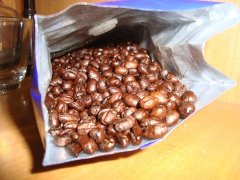
Fine coffee beans recommend Yunnan small coffee beans
Coffee cherry fruit generally has two flat seeds, if one does not grow properly, only one bean seed sprouts, in a fruit there is only a small round bean (deformed), with a small crack in the middle, it is called pea-shaped coffee bean (peaberry). Round beans (Peaberry) are also known as perle, Perla and caracol. A normal Arabica.
2014-11-12 Coffee knowledge boutique coffee beans Yunnan coffee small coffee beans
Coffee Bean Workshop in Baoshan, Yunnan
In Baoshan City, Yunnan Province, people divide the climate change in the year by the rainy season and the dry season. It is a quiet and sunny afternoon. Kapok trees sort out their branches and leaves in the warm spring wind. It will soon fill the whole courtyard with the fragrance of marshmallow. Tian Daihe decided whether or not to go to the kindergarten in Lujiang Town according to his own mood.
2014-07-09 Yunnan Baoshan coffee bean workshop Yunnan coffee bean
Introduction of main Coffee (4)
14. Vietnam Coffee (Vietnam Coffee): Vietnam is the first place in Indo-China to grow coffee. Because it was once a colony of France, it has a habit of drinking coffee for a long time, but the general folk way of drinking coffee is very similar to that of Indonesia. At present, its output has leapt to the second place in the world, with Romsda as the bulk. 15. Indian coffee (India Coffee): Indian coffee in recent years
2014-08-22 Main Coffee introduction 14.Vietnam Vietnam Cof
General situation of Coffee Bean Workshop in Baoshan, Yunnan Province
In Baoshan City, Yunnan Province, people divide the climate change in the year by the rainy season and the dry season. It is a quiet and sunny afternoon. Kapok trees sort out their branches and leaves in the warm spring wind. It will soon fill the whole courtyard with the fragrance of marshmallow. Tian Daihe decided whether or not to go to the kindergarten in Lujiang Town according to his own mood.
2015-02-16 Yunnan Baoshan coffee beans workshops China coffee general situation Baoshan City Lao