“Nile” search results (215)

Introduction to the flavor and taste characteristics of high-quality coffee beans in Burundian coffee producing areas
Coffee production in Burundi became privately owned in 2007, however, a considerable amount of government intervention and similar bribery still exist. On one occasion, a competitor's processing farm defrauded farmers of their salaries (only half paid, which is quite common in Burundi) in an attempt to prevent production farmers from cooperating with LMCP. They bribed local officials, blocked roads and hired a
2016-09-20 Burundi coffee variety producing area boutique coffee beans flavor taste characteristics introduction
Geological characteristics of coffee geomorphology in Ethiopia
The Ethiopian Plateau (16 pieces) the Ethiopian Plateau is formed by crustal faults, uplift and lava accumulation. Generally 2500-3000 meters above sea level, many extinguishing volcanoes are more than 3500 meters, and the highest Dashang peak is 4620 meters. It is the highest plateau in Africa and a typical lava platform. It covers an area of more than 800,000 square kilometers, with an average elevation of 2500
2016-06-13 Ethiopia Coffee geomorphology Features Geology Geomorphology Editor
Geological characteristics of coffee geomorphology in Ethiopia
The Ethiopian Plateau (16 pieces) the Ethiopian Plateau is formed by crustal faults, uplift and lava accumulation. Generally 2500-3000 meters above sea level, many extinguishing volcanoes are more than 3500 meters, and the highest Dashang peak is 4620 meters. It is the highest plateau in Africa and a typical lava platform. It covers an area of more than 800,000 square kilometers, with an average elevation of 2500
2016-06-13 Ethiopia Coffee geomorphology Features Geology Geomorphology Editor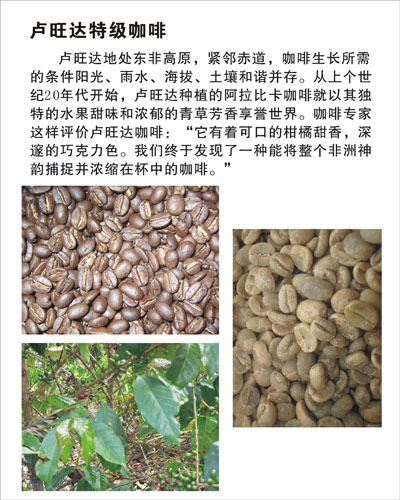
The aroma and throat rhyme of Arabica in the African region of Rwanda continues to be strong and solid characteristic coffee beans.
Rwandan coffee is absolutely high quality in the form of washed Arabica beans. As far as Africa is concerned, its coffee industry stands out because the country rises and falls by producing the best possible beans. The taste of Rwandan coffee is described as a grassy aroma with tropical climate characteristics. The country's fertile soil and climate help plants grow, and coffee trees seem to be driven
2015-12-29 Africa producing area Rwanda country Rabbi aroma throat persistent rich solid
Introduction to the Flavor and Taste characteristics of Burundian Coffee Manor
There are two major ethnic groups in Burundi, and only about 15 percent of the Tutsi have ruled the country since the 16th century, controlling the civilian population, which is mainly made up of Hutu, plus a very small number of indigenous Twa. This abnormal social structure in which ethnic minorities occupy a high position has buried the evil seed of national instability, and in 1
2016-08-24 Flavor sweetness Burundi coffee manor producing area taste characteristics boutique introduction
Introduction to the characteristics of Burundian Coffee flavour Manor with Fruit Flavor
There are two major ethnic groups in Burundi, and only about 15 percent of the Tutsi have ruled the country since the 16th century, controlling the civilian population, which is mainly made up of Hutu, plus a very small number of indigenous Twa. This abnormal social structure in which ethnic minorities occupy a high position has buried the evil seed of national instability, and in 1
2016-08-26 Rich fruit flavor Burundi coffee taste manor producing area characteristics introduction
Sidamo Shakiso Coffee country of Origin-Flavor description Variety introduction of the Manor
Origin: blind test in Xidamo Shachiso producing area in southern Ethiopia: Ethiopian coffee is mainly in the sun, but now it seems to have changed in recent years, and the fine coffee movement has made people's mouths more and more picky. Less gossip, the aroma is obvious: according to Westerners, it is rose tea, but I think it is more like a lighter brown sugar ginger soup, as well as honey and oranges.
2016-09-19 Dharma Shaquiso Coffee Origin country Flavor description Manor characteristics products
Rwanda Coffee Flavor Description Region Characteristics Roast Degree Boutique Coffee Bean Introduction
New administrative divisions were introduced on 1 January 2006. Rwanda is divided into four provinces (Rwandan: intara): Province de l'Est, Province du Nord, Province de l'Ouest, Province du Sud, Ville de Kigali and one municipality (Kigali), comprising 40 provinces.
2016-09-27 Rwanda Coffee Flavor Description Region Characteristics Roast Degree Fine
Introduction to the characteristics of Coffee Bean Flavor Manor in Rwanda
There are about 33000 hectares of coffee plantations in Rwanda, with 500000 people engaged in the coffee industry. With the good natural conditions of high altitude and fertile volcanic soil, the country's fertile soil and suitable climate contribute to plant growth, and coffee trees seem to be driven or forced to grow upward, or because they grow too fast to produce the best coffee beans. Luwang, the beautiful land of a thousand hills
2016-08-05 Rwanda coffee beans flavor taste manor producing area characteristics introduction Mayer
Introduction to the characteristics of Coffee Variety of Coffee Manor in Xidamo Shachiso producing area
Ethiopia is the birthplace of coffee. Ethiopian coffee has the same deep cultural accumulation as Chinese tea. The Sidamo producing area, which is 1400-2200 meters above sea level, is a famous boutique coffee area in southern Ethiopia, bordering Kenya. The washed Sidamo is light green, the beans are small, the growth is oval, the fruit is full, the average quality is good, the smell is aromatic and mellow, one drop.
2016-09-20 Dharma Shaquiso producing area Coffee Manor Origin Variety characteristics introduction E
Burundian Coffee with excellent acidity Flavor description of Burundian Coffee characteristics of Fine Coffee beans
10.5 million (2014). It consists of three tribes: Hutu (84%), Tutsi (15%) and Tewa (1%). The official languages are Kirundy and French, Mandarin is Kirundy, and some residents speak Swahili. Among the residents, 61% believe in Catholicism, 24% believe in Protestantism, 3.2% believe in primitive religions, and the rest believe in other religions or do not. The proportion of the population is: male accounts for the total
2016-09-30 Acidity excellent Burundi coffee grinding flavor description boutique coffee beans special
Introduction of Ugandan Coffee Bean Flavor Coffee beans from Uganda Coffee Manor
National flag: rectangular, the ratio of length to width is 3 ∶ 2. From top to bottom, it is composed of six parallel and equal wide stripes of black, yellow and red, and there is a white circle in the center of the flag, including a Ugandan national bird crown crane. Black represents the Ugandan people, symbolizing blacks; yellow symbolizes sunshine; red symbolizes freedom, and the tricolor combination means that the Ugandan people gain independence under the sun.
2016-07-26 Uganda coffee beans flavor introduction coffee manor boutique national flag rectangle
Introduction to the description of extraction time and flavor of coffee varieties in Erida Manor
Balu is a young volcano, more than 3400 meters above sea level, is an active volcano, surrounded by seven different micro-climatic zones, brewing a rich variety of ecology. The diverse microclimate has both advantages and disadvantages for coffee cultivation, but for Arida, her flavor is stronger and more obvious than most Panamanian beans, and her black berry aftertaste and varied taste make her a glutton.
2016-10-19 Ethiopia Obi Allie Manor Coffee Taste producing area extraction time
Introduction to the characteristics of fine coffee beans in the manor producing area of Tanzania coffee flavor and taste
Archaeological data from many Neolithic sites found in Tanzania prove that about 3,000 years ago, its main residents were the Koisan (see Bushmen), who made a living by hunting and gathering. In the early 1000 BC, the southern branch of the Kucht spread southward along the East African Rift Valley and reached north-central Tanzania, where it was the earliest farming inhabitant. In the centuries BC, the Bantu came from the west.
2016-08-10 Granules full Tanzania coffee flavor taste manor producing area characteristics essence
An introduction to the unique soft floral aroma of Ethiopia's Yega Snow Aduoda Coffee growing Environment
Ethiopia is located at 6 ~ 9 degrees north latitude and 34 ~ 40 degrees east longitude. It is located in the center of the Horn of Africa and is a landlocked country. It is bordered by Djibouti and Somalia to the east, Sudan to the northwest, Eritrea to the north and Kenya to the south. [5] there are mainly mountain plateaus in Ethiopia, and most of them belong to the Ethiopian plateau. The central and western regions are the main body of the plateau, accounting for the whole territory.
2016-08-17 Unique soft fragrant Ethiopia Yega Chevy Duoduo Coffee planting
Jasmine scented Ethiopian Yega Sheffivoka Coffee growing Environment Fine Coffee is introduced.
Ethiopia is located at 6 ~ 9 degrees north latitude and 34 ~ 40 degrees east longitude. It is located in the center of the Horn of Africa and is a landlocked country. It is bordered by Djibouti and Somalia to the east, Sudan to the northwest, Eritrea to the north and Kenya to the south. [5] there are mainly mountain plateaus in Ethiopia, and most of them belong to the Ethiopian plateau. The central and western regions are the main body of the plateau, accounting for the whole territory.
2016-08-17 Jasmine incense Ethiopia Yega Sheffield Waka Coffee planting Environment
Rich and charming fruity coffee flavor and taste area of Yega Fischer Manor in Ethiopia
Ethiopia is located at 6 ~ 9 degrees north latitude and 34 ~ 40 degrees east longitude. It is located in the center of the Horn of Africa and is a landlocked country. It is bordered by Djibouti and Somalia to the east, Sudan to the northwest, Eritrea to the north and Kenya to the south. [5] there are mainly mountain plateaus in Ethiopia, and most of them belong to the Ethiopian plateau. The central and western regions are the main body of the plateau, accounting for the whole territory.
2016-09-02 Rich charming fragrant Ethiopia Yega Shefico Cher Manor Coffee
Burundian Coffee Flavor with Fruit Flavor; introduction to the characteristics of fine coffee beans in the manor area
Formerly known as Urundi, Burundi formed a feudal kingdom in the 16th century. Since the middle of the 19th century, the forces of Britain, Germany and Belgium invaded. The long-ruled monarchy, which was conquered by Germany in 1890, listed it as the territory of German East Africa and fell under the control of the Belgian army in 1916. After World War I, the League of Nations merged Rwanda-
2016-08-11 Rich fruit flavor Burundi coffee taste manor producing area characteristics boutique
Burundian Coffee Flavor and taste introduction to boutique coffee beans in manor area
There are two major ethnic groups in Burundi, and only about 15 percent of the Tutsi have ruled the country since the 16th century, controlling the civilian population, which is mainly made up of Hutu, plus a very small number of indigenous Twa. This abnormal social structure in which ethnic minorities occupy a high position has buried the evil seed of national instability, and in 1
2016-08-25 Burundian coffee flavor taste manor producing area characteristics boutique coffee beans introduction
Introduction to the flavor and taste characteristics of Ethiopian coffee manor with soft acidity
There are mainly mountain plateaus in Ethiopia, and the central and western regions are the main part of the plateau, accounting for 2% of the whole territory. The East African Rift Valley runs through the whole territory, with an average elevation of nearly 3000 meters, which is known as the roof of Africa. The terrain around the plateau is gradually declining. The Darol depression in the north fell to 113 meters below sea level, the lowest point in the country. A narrow banded plain along the coast of the Red Sea
2016-08-16 Acidity softness Ethiopia coffee manor producing area flavor taste characteristics