“Fruits” search results (7573)

List several ways to treat fresh coffee fruits into raw coffee beans
The variety of coffee treated with raw beans certainly determines the natural flavor, but the treatment of raw beans determines the acquired quality. Selected coffee attaches great importance to flavor and quality, so it pays special attention to the technology and details of processing.
2014-09-01 Coffee knowledge coffee fresh fruit treatment coffee raw beans coffee encyclopedia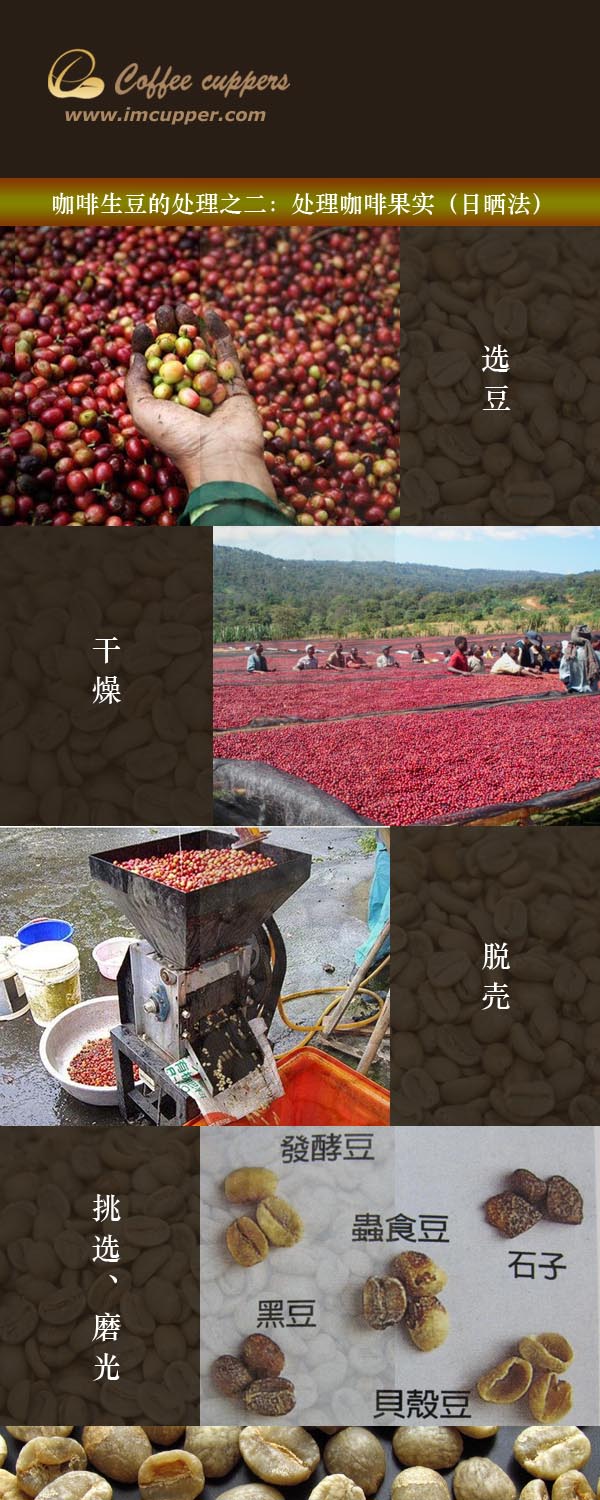
Processing of green coffee beans: processing coffee fruits (solarization method)
The coffee variety determines the natural flavor, but the treatment of the green beans can determine the acquired quality. Coffee selection attaches the most importance to flavor and quality, so special attention is paid to the technique and detail of processing. Harvested fruit must be processed immediately, otherwise it will begin to ferment and produce off-flavor coffee beans. There are two methods of treatment: sun drying (San-Dry) and washing (Washing).
2015-11-27 coffee green beans processing fruit sun
Treatment of Coffee fruits-- washing
When the coffee fruit is harvested from the mountain, the next step is to remove the peel and pulp of the coffee beans. There are two main ways of treatment: washing and solarization. But the ultimate determining factor is whether there is enough water to use. Some special boutique coffees are both insolated and washed.
2014-08-22 Coffee knowledge coffee fruit treatment coffee bean treatment washing
Coffee training basics-from fruits to raw coffee beans
Coffee training basics-from fruit to raw coffee beans: a coffee tree can harvest 3-5 kilograms of fruit, and raw coffee beans account for 5% of the fruit quality. Going from fruit to raw coffee beans is really a time-consuming and laborious task. Arabica and Robusta Arabica coffee account for about 2% of the world's coffee production. The plant is not suitable for high temperature, low temperature, more rain and less rain.
2014-10-08 Coffee knowledge coffee basics coffee fruits coffee raw beans
Introduction of several fermentation processes in the production of Indonesian civet coffee Kopi Luwak
At present, there are still two modes of production of civet coffee in Indonesia. One is the civets from the wild, which need someone to collect the civet poop that can be found like mushrooms, and then do the sun or water washing treatment. However, because the civet is a nocturnal animal, lives in the jungle area and does not eat much, the coffee beans produced by wild civets are very rare. that
2016-09-20 Indonesia musk coffee cat shit mode of production several fermentation process introduction now
On the treatment of Coffee beans introduction of Honey treatment of Coffee fruits and its difference from others
A few years ago, a fad of expensive Indonesian Kopi Luwak introduced domestic consumers to the concept of diversified production technologies for boutique coffee, and then the emergence of sparrow shit coffee in Brazil and shit coffee in Thailand was a bit like an odd coffee zoo war. When it comes to the new stars in the production process of boutique coffee, honey treatment has to be mentioned. At the WSC contest, which is known as the Coffee World Cup
2016-01-11 About coffee beans treatment methods coffee fruits introductions other different years
Introduction to the taste grindability of high-quality coffee beans
Rwanda's economy is dominated by agriculture. The population engaged in agriculture and animal husbandry accounts for 92% of the country's population. The main cash crops are coffee, tea and cotton. Because it is an agricultural and animal husbandry country, coupled with the loss of many young workers caused by the genocide in 1994, it is a huge blow to a country that is not already rich, and Rwanda is still a backward country. Luwang after the Civil War
2016-09-28 Rwanda coffee flavor description variety characteristics boutique coffee beans taste research
Introduction to the characteristics of Bolivian coffee flavor varieties with sour taste of citrus fruits
In the past, most of the coffee in Bolivia was of average quality, but in recent years, the production of boutique coffee has developed rapidly, and there have been a lot of pretty good beans. In recent years, the COE (Cup of excellence) system, which was first implemented in Brazil, has gradually become popular. Bolivia has also introduced this system, which can stimulate the enthusiasm of coffee farmers on the one hand and stimulate coffee farmers on the other.
2016-09-14 Oranges fruits sour Bolivia coffee flavor taste variety producing area special
Get more antioxidants from coffee than other diets
Adequate intake of a diet rich in antioxidants, including drinking coffee, is the root cause of many human natural processes, such as aging and cardiovascular diseases.
2014-08-28 Coffee knowledge antioxidants coffee ingredients
Introduction to the flavor and taste of the soft and fragrant Rwandan Coffee Manor
The coffee fruit needs to be transported to the processing plant as soon as possible after picking, but due to the lack of domestic facilities, it is unable to deal with the fruit at the first time. The fruits are piled up after being picked, which will continue to develop and accelerate mildew and decay due to lack of ventilation. Rotten fruits will affect the quality of coffee and show defective flavor. In recent years, the production and processing of coffee in Rwanda are
2016-08-06 Soft fragrant Rwanda coffee manor producing area flavor taste characteristics introduction
Introduction to the characteristics of flavor and taste varieties of Honduran coffee beans in planting environment
The granules of coffee beans in Honduras are large in shape, uniform in size and glossy in color. In order to facilitate harvesting, farmers will prune the coffee trees to no more than 150 centimeters, because if they grow too high, they have to set up ladders to pick, which is not only time-consuming, but also may damage the trees by bending branches. As the ripening period of each fruit of the coffee bean is different, it is necessary to keep the coffee bean in good condition.
2016-10-19 Honduras coffee beans flavor taste variety characteristics planting environment grinding
Coffee technology processes fresh coffee fruits into raw coffee beans.
The variety of coffee treated with raw beans certainly determines the natural flavor, but the treatment of raw beans determines the acquired quality. Selected coffee attaches great importance to flavor and quality, so it pays special attention to the technology and details of processing. Harvest: the harvest method is one of the criteria for judging selected coffee. if calculated from the time of germination, Arabica coffee will take about 5 years to blossom and bear fruit. Brazil
2014-10-09 Coffee knowledge coffee technology coffee fresh fruit coffee raw bean
The technique of treating fresh Coffee fruits into Coffee Raw beans
The variety of coffee treated with raw beans certainly determines the natural flavor, but the treatment of raw beans determines the acquired quality. Selected coffee attaches great importance to flavor and quality, so it pays special attention to the technology and details of processing. Harvest: the harvest method is one of the criteria for judging selected coffee. if calculated from the time of germination, Arabica coffee will take about 5 years to blossom and bear fruit. Brazil
2015-10-15 Coffee fresh fruit treatment raw beans skills coffee beans processing coffee varieties
The process of turning fresh coffee fruits into raw coffee beans.
The variety of coffee treated with raw beans certainly determines the natural flavor, but the treatment of raw beans determines the acquired quality. Selected coffee attaches great importance to flavor and quality, so it pays special attention to the technology and details of processing. Harvest: the harvest method is one of the criteria for judging selected coffee. if calculated from the time of germination, Arabica coffee will take about 5 years to blossom and bear fruit. Brazil
2014-12-30 Coffee technology fresh fruit treatment raw beans process processing coffee varieties
How coffee fruits turn into raw beans
There are three kinds of refining methods: drying type, washing type, and the compromise between the two-semi-washing type.
2014-08-22 Coffee knowledge coffee raw beans coffee bean processing
Sun Yega Chefen Wauka characteristic Sun Yega Snow Coffee Wauka Flavor
The beans are small, neat and round. Ethiopian sun beans are generally G3--G5, but the beans are G2, equal to the grade of washed beans. Although there are still a few defective beans, they are commendable compared to the sun beans of Harald and Sidamo. The 2015 sun Yega snow caffeine has appeared in the G1 grade, surpassing the G1 washing in terms of quality and sales. This bean is baked
2016-09-01 Sun Yega Schiffe Wauka characteristics Flavor Snow beans
The skill of turning fresh coffee fruits into fresh coffee beans
The variety of coffee treated with raw beans certainly determines the natural flavor, but the treatment of raw beans determines the acquired quality. Selected coffee attaches great importance to flavor and quality, so it pays special attention to the technology and details of processing. Harvest: the harvest method is one of the criteria for judging selected coffee. if calculated from the time of germination, Arabica coffee will take about 5 years to blossom and bear fruit. Brazil
2015-04-20 Coffee fresh fruit processing fresh beans techniques raw beans coffee varieties of course
The difference between Yega Snow Coffee G1 and G2 Yega Snow Coffee Coffee characteristic Sun Yega Snow Coffee
The beans are small, neat and round. Ethiopian sun beans are generally G3--G5, but the beans are G2, equal to the grade of washed beans. Although there are still a few defective beans, they are commendable compared to the sun beans of Harald and Sidamo. The 2015 sun Yega snow caffeine has appeared in the G1 grade, surpassing the G1 washing in terms of quality and sales. This bean is baked
2016-08-31 Yega Snow Coffee difference Coffee characteristic Sun Snow beans
Rwanda Coffee Flavor description, Grinding degree Taste characteristics, Flavor description of Fine Coffee beans in producing areas
Rwanda's economy is dominated by agriculture. The population engaged in agriculture and animal husbandry accounts for 92% of the country's population. The main cash crops are coffee, tea and cotton. Because it is an agricultural and animal husbandry country, coupled with the loss of many young workers caused by the genocide in 1994, it is a huge blow to a country that is not already rich, and Rwanda is still a backward country. Luwang after the Civil War
2016-10-09 Rwanda coffee flavor description grinding taste characteristics variety producing area boutique
The so-called 'yejia sherry' refers to the rich jasmine flowers, lemon and peach, almond sweet
Sun-baked yeka coffee, beans are small and neat short round shape, Ethiopian sun-baked beans are generally G3-G5, but this bean is G2, equal to the grade of washed beans, although there are still a few defective beans, but compared with Harald and Sidama sun-baked beans, is valuable. 2015 Sun-baked yeja sherphine, already G1 grade, exceeds G1 wash in quality and appearance. This bean is baked
2016-09-01 the so-called yega and sherphine refer to rich jasmine floral lemon and peach.