“Components” search results (1644)

The key components of coffee grounds can absorb sulfur.
Researchers at the City University of New York report that coffee grounds can absorb hydrogen sulfide gas and sulfur well.
2014-08-27 Coffee knowledge coffee function coffee health coffee grounds use

Table of nutritional components of boutique coffee
Every 100 grams of coffee liquid contains 99.5 grams of water, 0.2 grams of protein, 0.1 grams of fat, 0.1 grams of ash, trace sugars, 3 mg of calcium, 4 mg of phosphorus, 2 mg of sodium, 0.01 mg of vitamin B2 and 0.3 mg of nicotinic acid. Dissolve 10 grams of coffee in hot water with 0.04 grams of caffeine and 0.06 grams of tannins.
2014-10-25 Coffee knowledge boutique Coffee Science Coffee nutritional composition Table
The main chemical components of coffee beans
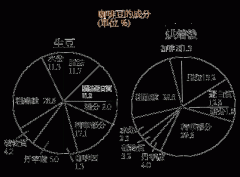
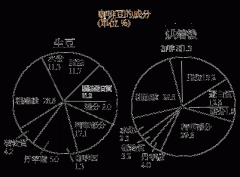
The main chemical composition of green coffee beans: composition content (%) carbohydrate 60.0 reducing sugar 1.0 sucrose 7.0 pectin 2.0 starch 10.0 tulose 5.0 hemicellulose 15.0 total cellulose 18.0 lignin 2.0
2014-10-29 Coffee knowledge fine coffee science coffee bean ingredients chemical composition

Table of nutritional components of boutique coffee basic life coffee
Every 100 grams of coffee liquid contains 99.5 grams of water, 0.2 grams of protein, 0.1 grams of fat, 0.1 grams of ash, trace sugars, 3 mg of calcium, 4 mg of phosphorus, 2 mg of sodium, 0.01 mg of vitamin B2 and 0.3 mg of nicotinic acid. Dissolve 10 grams of coffee in hot water with 0.04 grams of caffeine and 0.06 grams of tannins.
2015-01-05 Boutique coffee foundation life nurturance sub-table 100 body moisture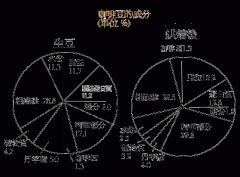
Main components of coffee
Caffeine: has a particularly strong bitter taste and stimulates the central nervous system, heart and respiratory system. Moderate caffeine can also reduce muscle fatigue and promote digestive secretion. Because it promotes kidney function, it has a diuretic effect and helps the body expel excess sodium ions from the body. Too much caffeine can lead to caffeine poisoning. Tannin: Boiled tannin decomposes into pyrolytic acid,
2014-08-07 Coffee knowledge Coffee main ingredients Coffee encyclopedia
The key components of coffee grounds can absorb sulfur.
There is good news for coffee lovers around the world: the large amount of coffee grounds they throw away helps remove the toxic smell of dirt. In the American Journal of Hazardous Materials, researchers at the City University of New York published a study saying that coffee grounds can absorb hydrogen sulfide gases, which are often caused by the fact that the dirt smells so bad. Now the common practice is to use activated carbon.
2015-06-23 Coffee key ingredients can adsorption sulfur global coffee lovers good consumption
The key components of coffee grounds can absorb sulfur.
There is good news for coffee lovers around the world: the large amount of coffee grounds they throw away helps remove the toxic smell of dirt. In the American Journal of Hazardous Materials, researchers at the City University of New York published a study saying that coffee grounds can absorb hydrogen sulfide gases, which are often caused by the fact that the dirt smells so bad. Now the common practice is to use activated carbon.
2015-10-05 Coffee key ingredients can adsorption sulfur global coffee lovers good consumption
The aroma components of coffee are easy to dissipate. How to preserve the best aroma quality of coffee?
The aroma components tend to dissipate the rich aroma of fresh coffee when ground, inspiring poets for hundreds of years. In order to capture these aromas in coffee cups, all kinds of beautiful shapes and strange coffee machines have come out one after another, thus achieving this arduous super task. Why is it so difficult to make brewed coffee as fragrant as freshly ground coffee?
2016-01-18 Coffee main ingredient aroma easy to dissipate how retain good quality
The main components of coffee beans
The fiber of fiber raw beans will be carbonized after baking and combine with caramel to form the hue of coffee. The main source of protein calories, the proportion is not high. Most of the protein in coffee powder will not dissolve out when brewing coffee, so the intake is limited. Sugar coffee raw beans contain about 8% sugar. After baking, most of the sugar will be converted to caramel, making the coffee brown.
2016-05-24 Coffee beans main ingredients fiber raw beans roasting carbonization caramel combination shape
Classify the smell of coffee by source
According to the source, the aromatization table can be divided into three groups: the first group: this kind of compound is the result of enzymatic reaction during the growth of coffee beans. The main components are ester and aldolase. This compound is the most volatile and is often found in the dry aroma of freshly ground coffee powder. The first group can be further subdivided into three types: floral flavor, fruit flavor and
2014-09-12 Coffee knowledge division of coffee coffee smell
The expression of alcohol and strength in the analysis of coffee components
For coffee, the touch of the mouth and palate comes from fatty oil, a liquid ingredient insoluble in water, and a sediment suspended in coffee water after brewing. In addition to providing texture for the overall taste of coffee, suspended matter in coffee also affects the taste of coffee by forming colloids. 1.Fatty oil raw coffee beans contain 7% Mui 17% fat.
2015-09-16 Coffee composition analysis mellowness strength expression
Analysis of the aroma of coffee from a chemical point of view
Whether you are a coffee expert or an ordinary coffee lover, you will be attracted by the attractive aroma of that freshly ground coffee every morning. What you don't know is that this fragrance actually contains thousands of chemicals. To give you a better understanding of the chemical components of coffee aroma, we have drawn the following chart: in the face of such a complex chemical symbol, you may be
2015-08-25 Chemistry angle analysis coffee aroma
The smell of coffee according to its source is of great reference value for roasting.
According to the source, the aromatization table can be divided into three groups: the first group: this kind of compound is the result of enzymatic reaction during the growth of coffee beans. The main components are ester and aldolase. This compound is the most volatile and is often found in the dry aroma of freshly ground coffee powder. The first group can be further subdivided into three types: floral flavor, fruit flavor and
2015-11-24 According to source division coffee smell baking very reference value according to