“132” search results (90)
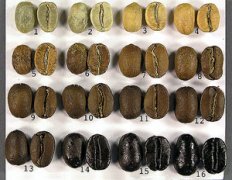
The picture and text of roasting coffee beans shows that there are different degrees of changes from raw beans to roasting.
Naked eye observation as one of the methods to determine the roasting degree of coffee beans is very limited when used alone. If it is supplemented by the judgment of burst sound and the discrimination of fragrance, quite accurate results can be obtained. But the world of coffee is full of surprises and rarely conventional, and explosive Sumatra is often mistaken for urban baking. On the other hand, the color of some coffee beans after roasting will look better than that of actual roasting.
2015-09-10 Coffee beans roasting picture and text description raw beans different degrees changes coffee beans
Coffee Basics About Coffee Trees and Caffeine
Linnaeus classified coffee plants in the Rubiaceae family, e.g. Gardenia. The great naturalist named it Coffea. Although plants in the wild can grow to 10-12 metres tall, those in plantations are about 3 - 5 metres tall, except in Colombia, where few species exceed 2 metres. This makes farming and picking easier and cultivation more economical. leaves
2014-09-11 coffee knowledge coffee basics coffee tree caffeine
Basic knowledge of all aspects of coffee
Linnaeus (Swedish naturalist) classifies coffee plants into the Rubiaceae family, such as gardenia. The great naturalist named it Coffea. Although wild plants can grow as high as 10-12 meters, the plantations are about 3 to 5 meters high, with the exception of Colombia, where tree species rarely exceed 2 meters. This makes farming and picking easier and more economical to cultivate. Leaves
2015-08-25 About coffee parties noodles basic knowledge
A comprehensive introduction to all aspects of coffee-coffee beginners must see the knowledge.
Linnaeus (Swedish naturalist) classifies coffee plants into the Rubiaceae family, such as gardenia. The great naturalist named it Coffea. Although wild plants can grow as high as 10-12 meters, the plantations are about 3 to 5 meters high, with the exception of Colombia, where tree species rarely exceed 2 meters. This makes farming and picking easier and more economical to cultivate. Leaves
2015-12-03 Coffee generous noodle simple introduction beginner must see knowledge point
Basic knowledge of all aspects of coffee decaf coffee
Linnaeus (Swedish naturalist) classifies coffee plants into the Rubiaceae family, such as gardenia. The great naturalist named it Coffea. Although wild plants can grow as high as 10-12 meters, the plantations are about 3 to 5 meters high, with the exception of Colombia, where tree species rarely exceed 2 meters. This makes farming and picking easier and more economical to cultivate. Leaves
2015-10-07 About coffee parties noodles basics caffeine
The basic knowledge of coffee encyclopedia on all aspects of coffee
Linnaeus (Swedish naturalist) classifies coffee plants into the Rubiaceae family, such as gardenia. The great naturalist named it Coffea. Although wild plants can grow as high as 10-12 meters, the plantations are about 3 to 5 meters high, with the exception of Colombia, where tree species rarely exceed 2 meters. This makes farming and picking easier and more economical to cultivate. Leaves
2014-10-16 Coffee knowledge coffee encyclopedia coffee basics
Basic knowledge about all aspects of coffee-baristas must see
Linnaeus (Swedish naturalist) classifies coffee plants into the Rubiaceae family, such as gardenia. The great naturalist named it Coffea. Although wild plants can grow as high as 10-12 meters, the plantations are about 3 to 5 meters high, with the exception of Colombia, where tree species rarely exceed 2 meters. This makes farming and picking easier and more economical to cultivate. Leaves
2015-11-24 About coffee all parties noodles basics knowledge points division will
The Green Dream of Yunnan Coffee
In 2012, Yunnan is expected to produce 60, 000 tons of coffee, accounting for 98% of the country's coffee production and 7/1000 of the world's coffee production. Pu'er City, as an important producing area of small grain coffee in Yunnan, by the end of 2011, the planting area of coffee is 439000 mu, the output is 28000 tons, the output value is 850 million yuan, the planting area and output account for more than half of the country respectively. This year, new plants will be planted in Pu'er City.
2014-04-27 Yunnan coffee green dream 2012 output forecast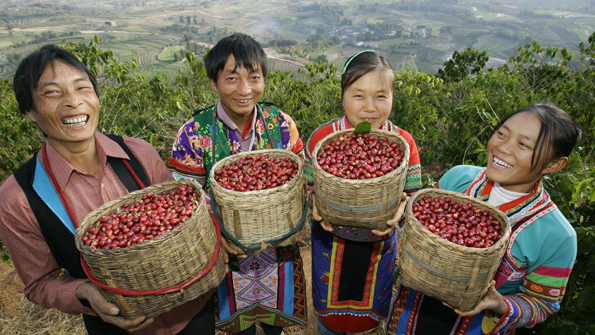
The green dream of Yunnan coffee is the only way to take intensive processing, and join the competition of international coffee giants.
Yunnan coffee was planted on a large scale in the mid-1950s, with a planting scale of 4000 hectares at one time. By the end of 1997, the planting area of coffee in the province had reached 7800 hectares. At present, the planting area of the province accounts for 70% of the national area, and the output accounts for 83% of the whole country. Yunnan coffee has established the dominant position in China in terms of planting area and coffee bean production. At present, Pu'er City is still there.
2016-07-08 Yunnan coffee green dream fine deep processing the only way join international
Research on Market Evaluation and Investment Planning of China's Coffee and Beverage Industry from 2016 to 2020
The "Research report on Market Evaluation and Investment Planning recommendations of China's Coffee and Beverage Industry from 2016 to 2020" released by Booz data introduces the relevant overview of the coffee and beverage industry, the operating environment of China's coffee and beverage industry, and analyzes the current situation of China's coffee and beverage industry, the competition pattern of China's coffee and beverage industry, and the operation of key enterprises in China's coffee and beverage industry.
2016-10-06 2016-2020 China coffee beverage industry market evaluation analysis