The relationship between coffee acid value and coffee roasting what does SCAA Agtron number mean
The simplest way is to distinguish by the appearance of coffee beans. From shallow to deep, the color of coffee beans will change from light brown to dark brown. As the roasting degree becomes deeper, the aroma will change from elegant and unrestrained flowers and fruits to strong creamy cocoa aromas.
Merchants need to use a more scientific method to judge the roasting degree, which is accurately defined by the roasting degree of the American Fine Coffee Association (SCAA), using the baking degree analyzer and the red inner line (IR) spectrum to measure the caramelization analysis value of coffee beans, which is the Agtron number mentioned by professional sellers.
The higher the Agtron number value is, the lower the caramelization degree, the lighter color and the lower baking temperature; on the contrary, the lower value indicates the higher caramelization degree, black brown color and higher baking temperature.
Baking degree: SCAA Agtron number
Agrton # 95-Extremely Light
Agrton # 85-Very Light
Agrton # 75-Light shallow baking
Shallow baking in Agrton # 65-Medium Light
Baking in Agrton # 55-Medium
Agrton # 45-Moderately Dark medium and deep baking
Agrton # 35-Dark
Agrton # 25-Very Dark
Baking degree analysis: the unique charm of different baking degrees
The acid value of coffee has a great relationship with the roasting degree. The longer the roasting time is, the higher the degree of caramelization is, and the more acidic substances are destroyed, the less sour and mellow the coffee is.
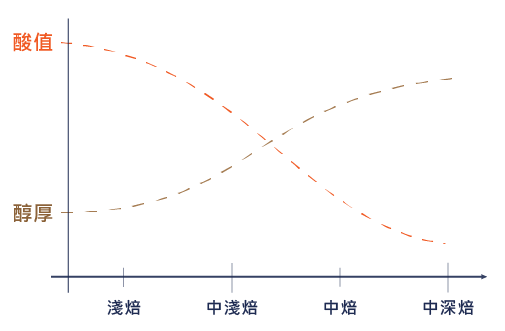
Noun interpretation
An explosion: First Crack, the first burst, raw beans begin to bake, will gradually absorb heat, heat so that the beans inside the gas and steam began to evaporate, followed by water vapor pressure so that the bean began to expand, the temperature is usually in 195o208 degrees Celsius (caused by different roasting machines or coffee beans) beans will reach an explosion time, at this time the compressed state of gas will be released in one breath, resulting in explosion sound, known as an explosion. In the following time, the burst will become denser and denser, which we call an explosion-intensive period.
Second explosion: Second Crack, the second burst, after the end of the first explosion, if the temperature continues to rise, the temperature is about 218 degrees Celsius 230 degrees Celsius, the principle is similar to the first explosion, because the deeper components inside the beans decompose again due to heat, with the expansion of the beans, ushered in the sound of explosion, known as the second explosion, but because it is the second burst, the sound is not as loud as the first burst.
Share
Follow Coffee Search for the latest coffee updates. Reproduced from "Coffee Search"
Article URL: https://www.coffeesearch.net/coffee142944.html
Related Articles
- Beginners will see the "Coffee pull flower" guide!
- What is the difference between ice blog purified milk and ordinary milk coffee?
- Why is the Philippines the largest producer of crops in Liberia?
- For coffee extraction, should the fine powder be retained?
- How does extracted espresso fill pressed powder? How much strength does it take to press the powder?
- How to make jasmine cold extract coffee? Is the jasmine + latte good?
- Will this little toy really make the coffee taste better? How does Lily Drip affect coffee extraction?
- Will the action of slapping the filter cup also affect coffee extraction?
- What's the difference between powder-to-water ratio and powder-to-liquid ratio?
- What is the Ethiopian local species? What does it have to do with Heirloom native species?