How to make a cup of good hand to pick defective beans? How to distinguish defective beans?
Professional coffee knowledge exchange more coffee bean information please follow the coffee workshop (Wechat official account cafe_style)
To make a good cup of hand, the barista will remove the defective beans before making coffee.
Let's learn how to pick defective beans and impurities.
Common impurities in coffee beans:
1. Stone
Coffee beans dried naturally in the sun are likely to be mixed with pebbles, gravel, wood chips and other foreign bodies. Occasionally a piece of glass or coins will be found.
2. Cereals
Like stones, coffee beans that are naturally dried in the sun may be mixed with cereals or seeds such as corn, and pepper grains have been seen.
Common defective bean patterns:
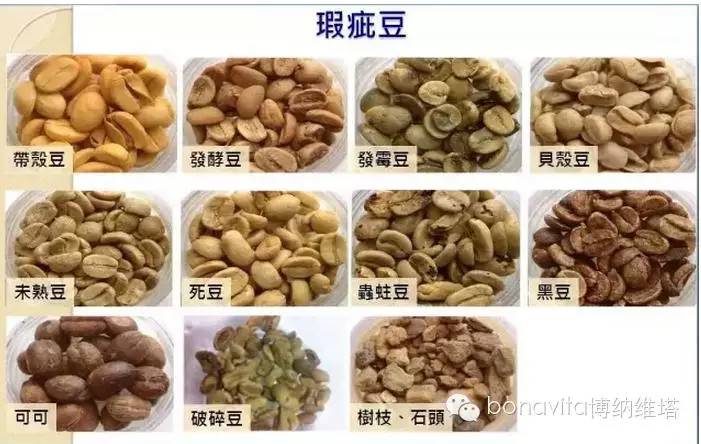
1. Shell beans, broken beans
Beans that become shell-shaped because of developmental problems are called "shell beans"; beans that are damaged during treatment or transportation are called "broken beans", both of which can cause uneven baking.
2. Fermented beans
When treated by water washing method, polluting fermented beans are produced in the fermentation tank. Delayed processing or improper preservation can also occur after harvest, and beans will smell funny when baked.
3. Moth-eaten beans
Because pests such as coffee bark beetles lay eggs on coffee trees, and the hatched larvae eat coffee fruits to form cavities, which is the reason for the turbid or strange taste of coffee.
4. Moldy beans
Beans that are moldy due to incomplete drying, transportation or improper preservation will remain moldy even after baking.
5. Unripe beans
Beans harvested before the coffee fruit is ripe. Coffee mixed with unripe beans will have a strong fishy smell, giving off a disgusting, smelly smell.
6. Black beans
Beans that fall black before harvest, or beans that are completely fermented and damaged. It is the source of the foul smell and rotten smell of coffee.
7. Dead beans
Beans that fail to bear fruit normally will lead to weak flavor and strange taste of coffee. The color after baking is also not good, so it is easier to distinguish after baking.
8. Smelly beans
The beans are dried when the flesh is attached, or the flesh is not completely removed. Stinky beans give off the smell of iodine or soil.
9. Sheepskin membrane beans
Due to incomplete shelling and other reasons, the beans with residual endocarp are the reasons for the astringent or miscellaneous taste of coffee.
-- END
For more professional coffee exchanges, please scan the code and follow Wechat: qiannjie

Please indicate the source of the reprint.
Share
Follow Coffee Search for the latest coffee updates. Reproduced from "Coffee Search"
Article URL: https://www.coffeesearch.net/coffee129007.html
Related Articles
- How did the Salvadoran coffee industry develop in Central America?
- What exactly does the golden cup extraction of coffee mean?
- The Origin of Coffee flower
- [2023 Starbucks World Earth Day] there are more meaningful things besides free Starbucks coffee!
- What kind of coffee is there in Spain? 9 Flavors of Spanish Coffee
- Aromatic African coffee| Kenya's coffee culture and historical production area
- Liberica Coffee Bean knowledge: the characteristics of Liberian Coffee beans of the three original species of Coffee beans
- The origin and formula of Spanish latte introduces the taste characteristics of Bombon coffee in Valencia, Spain.
- How to adjust the solution of over-extracted coffee
- What is the tasting period of coffee beans? What is the period of coffee and beans? How should coffee wake up and raise beans?